
What can I expect in the first session?
Our first session is focused on understanding what has brought you to therapy and beginning to develop a broader picture of your experiences. This is also an opportunity for you to ask questions and get a sense of me and how I work.
Therapy is most effective when you feel safe, understood, and able to work openly with your therapist. If you feel that I am not going to be the right fit for you, I won’t be upset or offended. It is more important that you find someone you can connect with. Likewise, if I believe another clinician would be better suited to your particular needs, I will discuss this with you as well.
How does the assessment and formulation process work?
Over the first few sessions we will map out your difficulties, key life events, important relationships, and recurring emotional or behavioural patterns. You may also be invited to complete some questionnaires to help clarify your symptoms or learn more about something like your attachment style or beliefs about yourself.
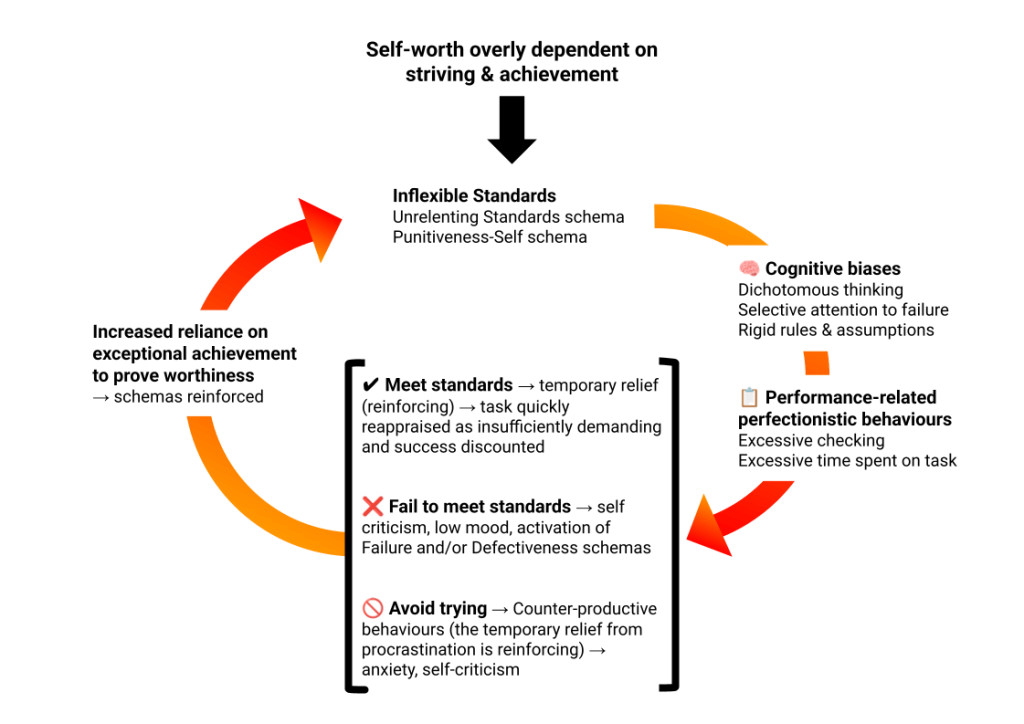
I then synthesise this information into a formulation that explains how your difficulties developed and what may be keeping them going. This helps us focus therapy on the specific beliefs, emotions, and behaviours that are maintaining your difficulties, making our work more precise and effective.
Here is an example of the maintaining factors in Clinical Perfectionism:
What if I’m not sure what’s wrong or how to explain it?
You do not need to arrive with a clear explanation. Many people come to therapy with a general sense that something is not right, without knowing exactly why.
A large part of my role is to help you make sense of your experiences. The assessment and formulation process allows us to gradually clarify patterns and identify what may be contributing to your unhappiness.
Will I have to talk about my past?
Understanding your past is often an important part of making sense of your current difficulties, but this process is always guided by your readiness and comfort. We will move at a pace that feels safe and manageable for you.
The goal is not to revisit difficult experiences unnecessarily, but to understand how certain patterns developed so that they no longer have the same hold over you. Many people find that putting their experiences into words, and understanding them in a new way, reduces their emotional intensity and helps them process and integrate painful or traumatic memories.
You remain in control of what you choose to share, and we will work collaboratively to ensure that therapy feels supportive and stabilising.
Are you a psychologist or counsellor?
I am a clinical counsellor. “Psychologist” is a legally restricted title. Although I completed formal training in clinical psychology, including all clinical coursework, placements, and final examinations, I did not complete the research component required for registration with the Psychologist Board.
I therefore practise as a ‘mental health therapist’ or ‘clinical counsellor’, but continue to work under regular supervision by a Registered Clinical Psychologist, to ensure high standards of clinical care and continued professional development so that I can provide the same level of competence and expertise as a psychologist. However, I cannot officially diagnose anything.
As a provisional member of the New Zealand Association of Counsellors, I am able to take on public health, ACC and EAP work.
Confidentiality
Confidentiality is vital for building trust and creating a safe space for open and honest communication, allowing you to feel completely comfortable sharing your thoughts and feelings, knowing that your privacy is respected and protected. What you talk about during our sessions is protected by the Health Information Privacy Code (HIPC 2020). You can tell anyone anything you like about our sessions, but I will treat your information as private and confidential.
All registered counsellors, psychotherapists and psychologists engage in regular supervision. I am supervised by a Registered Clinical Psychologist, whose job it is to keep me accountable while supporting me to offer my clients the best possible help. She is also ethically bound to protect everything that is discussed.
A rare exception to confidentiality might be if it emerges that there is a serious and imminent risk of harm to yourself or someone else. In this case I will always involve you in the decision-making around who to share this information with, to best ensure everyone’s safety.
Payment & Cancellations
Please do not bring cash to your appointment. After each session, you will be sent an invoice by email, which can be paid online by card or bank transfer.
Do provide at least 24 hours’ notice if you need to reschedule or cancel. There is no penalty for cancellations. Life can be unpredictable, and I understand that unexpected situations arise.
Therapy is most effective when it is regular and dependable. If attending sessions becomes difficult, we can talk about what may be getting in the way and decide together how best to proceed.


